
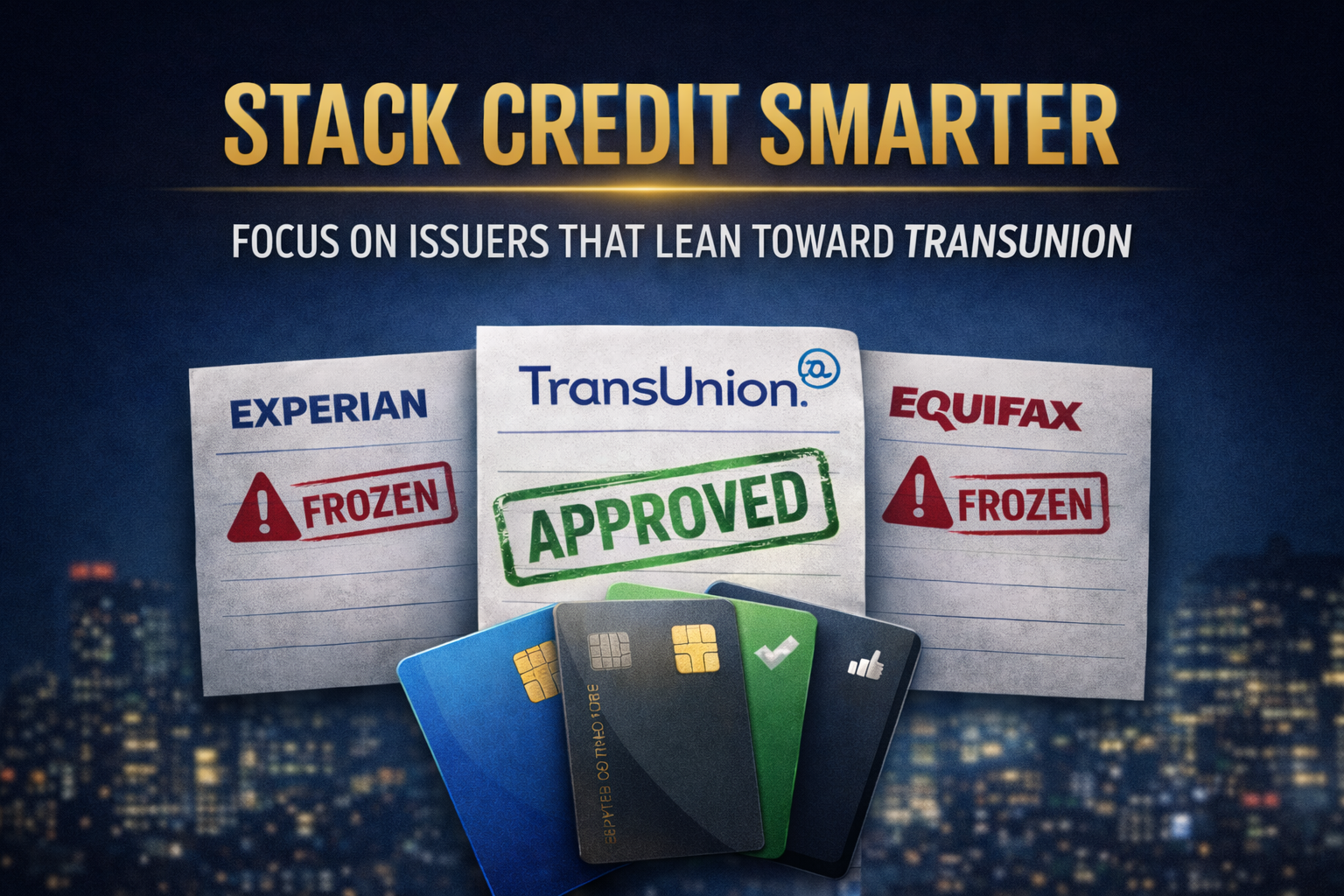
How to Target Credit Cards That Commonly Pull TransUnion
A smarter way to apply for credit without spreading hard inquiries across all three bureaus.
When most people apply for credit cards, they do it with no real plan.
They find a card they like, submit the application, and hope for the best. Then they repeat the same process with another issuer, and another after that.
The problem is that every time you apply, the lender may pull a different credit bureau. That usually means your inquiries can end up scattered across Experian, Equifax, and TransUnion.
For people trying to build or expand their credit strategically, that approach can get messy fast.
A more disciplined strategy is to focus on issuers that often rely on TransUnion, so more of your applications are concentrated with one bureau instead of spread everywhere.
It is never guaranteed that a bank will pull the same bureau every time, and lending decisions can vary by state, profile, and product. But some issuers are known to lean toward TransUnion often enough that many people build an application strategy around them.
Why some people focus on TransUnion
The appeal is simple.
If more of your applications land on one bureau, the other two reports may stay cleaner. That can matter when you are trying to preserve flexibility for future approvals, financing, or business credit moves.
Instead of creating inquiry activity across all three bureaus, a TransUnion-focused strategy aims to make your credit building more intentional.
This is especially useful for people who want structure rather than randomness in the way they apply.
Banks and issuers that often lean toward TransUnion
A small group of issuers makes this strategy possible because they are frequently reported to use TransUnion for certain products.
These commonly mentioned names include:
U.S. Bank
Often associated with TransUnion pulls and offers a mix of 0% APR cards, cashback cards, travel cards, and secured products.
BMO
Frequently included in TransUnion-focused credit strategies, depending on the card and market.
Synchrony
One of the biggest names in this space. Synchrony has a large ecosystem of retail and co-branded cards, and many applicants like the issuer because some products offer prequalification or pre-approval tools before a hard inquiry.
Navy Federal
Well known for strong limits and popular among members who qualify. Many people include Navy Federal in TransUnion stacking strategies because of its reputation for generous approvals and credit line growth.
Barclays
A more selective issuer, but still commonly mentioned in TransUnion-based application plans. Barclays offers several airline, travel, and retail cards.
Imprint
Imprint-backed cards have drawn attention because some applicants report seeing approval terms and even credit limits before fully accepting the offer.
Across these issuers, there are well over 100 credit card products combined, which is why this strategy gets so much attention.
The idea behind “controlling the pull”
One tactic people talk about is freezing certain credit bureaus before applying.
The logic is that if Experian and Equifax are frozen, a lender that can use TransUnion may rely on TransUnion instead.
This does not work every time, and no one should assume a freeze will force an approval or guarantee a specific bureau pull. Some lenders may simply deny the application, ask for additional verification, or decline to proceed.
Still, many applicants use bureau freezes as part of a broader credit strategy to reduce randomness and try to influence where inquiries appear.
Why Synchrony gets so much attention
Synchrony stands out because of the size of its card network and the number of consumer-facing brands it supports.
That includes cards tied to major retailers and platforms such as Amazon, PayPal, Venmo, Verizon, Lowe’s, and many others.
People often like Synchrony for three reasons:
- Some products offer prequalification or pre-approval paths
- Approvals can be more accessible than some major banks
- It is possible to hold multiple Synchrony accounts over time
For someone building available credit, that combination can make Synchrony a key part of a stacking strategy.
Why Navy Federal is a favorite for high limits
Among eligible members, Navy Federal is often praised for strong starting limits and the potential for significant growth.
That is why many serious credit builders put Navy Federal high on their list. Whether the goal is rewards, cashback, or a broader funding profile, Navy Federal is often seen as a major player in the TransUnion conversation.
Why Imprint is getting more attention
Imprint-powered cards have become especially interesting because some applicants report being shown meaningful approval details before final acceptance.
That creates a unique opening for people trying to be more precise with their applications.
Some refer to this as a three-step approach:
Step 1: Unfreeze TransUnion only
Step 2: Apply and review the offer details presented
Step 3: Refreeze TransUnion before taking the next step, where applicable
The reason this gets attention is that some people report receiving approval visibility without a traditional hard inquiry at the early stage.
Again, results vary, policies can change, and no one should treat that outcome as automatic. But it is one of the more talked-about angles in the current credit card strategy space.
What this can turn into over time
When done carefully, a TransUnion-focused strategy can help people build substantial total available credit across multiple issuers.
That does not mean applying recklessly or chasing limits for the sake of ego. It means understanding which issuers fit your profile, spacing applications properly, and using prequalification tools whenever possible.
For the right person, this kind of structure can lead to tens of thousands in available credit and, over time, potentially much more.
The bigger point is not just the amount of credit.
It is control.
Most people apply blind. Strategic applicants study the lenders, understand the bureau patterns, and move with intention.
Final thoughts
A TransUnion-focused credit strategy is not about gaming the system. It is about being more deliberate with your applications and protecting your overall profile from unnecessary inquiry clutter.
Not every bank will pull the same bureau every time. Not every profile gets the same result. And freezing bureaus is never a guarantee.
But if you understand which issuers commonly rely on TransUnion, use prequalification where available, and apply with a plan, you can make far smarter credit moves than the average applicant.